EU-HOSTED LLM GATEWAY
Route, protect, and monitor your AI requests.
One OpenAI-compatible gateway for your AI providers—with secret masking, automatic failover, and request tracing. Bring your own provider keys and see where your tokens and money go.
2,000 free requests · No card required · Paid plans from €19/month
Model usage is billed separately by your providers.
Mask supported secrets. Inspect every request.
When secret scanning is enabled, Heimdall checks supported prompt content for known secret patterns. Detected matches are replaced with deterministic placeholders before the request reaches OpenAI, Anthropic, Gemini, or any other provider. Detected values are kept in memory for response restoration. Detection is not exhaustive; scans can be skipped or fail, so review scan status and avoid sending sensitive data unnecessarily.
"content": "Debug this curl command:
curl -H Authorization: Bearer sk-proj-abc123xyz789secret"
"content": "Debug this curl command:
curl -H Authorization: Bearer <<HMD_SEC_a1b2c3d4>>"
A single URL. Dozens of models.
Switch providers without changing client code. Heimdall speaks OpenAI-compatible requests and routes to the right backend.
- OpenAI, Anthropic, Gemini, Azure, Mistral, Custom and many more
- Automatic retries with exponential backoff
- Custom tagging for analytics
curl https://api.heimdall.run/v1/chat/completionsKeep your application connected.
Configure model pools and fallback routes. When an eligible request fails, Heimdall can try another configured provider. Availability and response time depend on the providers, timeouts, and routing rules you choose.
Example routing flow
- Your application sends a request
- Heimdall selects a configured model
- A fallback handles eligible failures
- Inspect the route and result in traces
See what every AI request costs.
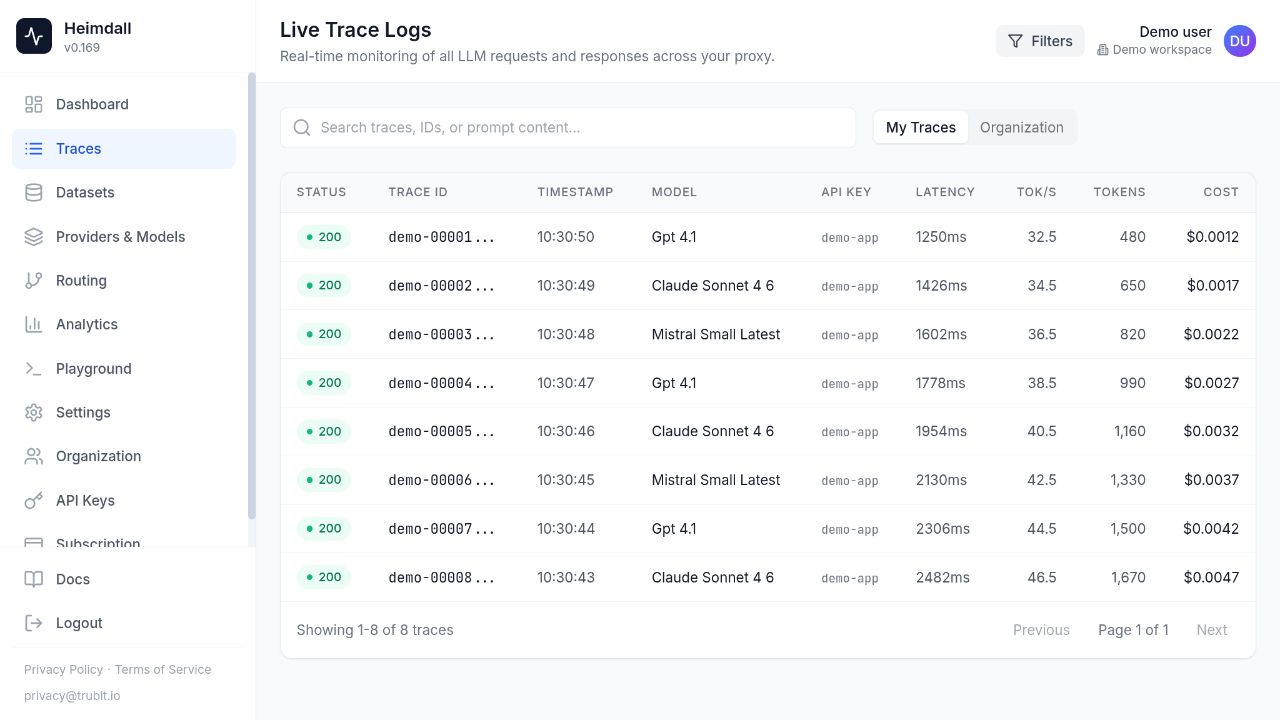
Request traces connect model selection, token usage, estimated cost, and latency. Investigate failures and compare usage across your applications.
Inspect requests
Review status, model, latency, and secret-scan results. Prompt and response visibility follows your content-storage settings.
Understand model spend
Track token counts and cost estimates. Your provider invoice remains the source of truth for model charges.
Find the right trace
Use custom tags to identify traffic from a project, environment, or workflow. Stored traces are retained for 30 days.
Built for production traffic.
From early experiments to enterprise scale, Heimdall keeps latency low and costs predictable.
One gateway, multiple providers
Use one OpenAI-compatible endpoint to call the providers and models configured for your organization.
Usage visibility
Track request volume, token usage, and estimated model costs across your applications.
Retries and fallbacks
Configure fallback models to handle eligible failures and inspect the result in your traces.
Request-level tracing
Inspect request details, token usage, latency, and model costs in your dashboard.
Automatic secret masking
Detect and mask supported API keys, tokens, and credentials before forwarding prompts. Detection can miss secrets, and scans can fail or time out; inspect scan status in traces and keep your existing security controls.
LLM gateway pricing. Start small, grow from here.
Choose your monthly request allowance. Routing, secret masking, and tracing are included in every plan.
Free Trial · €0
2,000 requests, available once. No card required. No automatic charge.
Hobby
For hobbyists and side projects
€19/month
50,000 requests/month
- Connect your own providers
- Routing and failover
- Masking for supported secrets
- Request tracing and cost analytics
- 30-day trace retention
- Self-service support
Starter
For small teams building with AI
€75/month
500,000 requests/month
- Connect your own providers
- Routing and failover
- Masking for supported secrets
- Request tracing and cost analytics
- 30-day trace retention
Professional
For growing production workloads
€200/month
1,500,000 requests/month
- Connect your own providers
- Routing and failover
- Masking for supported secrets
- Request tracing and cost analytics
- 30-day trace retention
Business
For higher-volume applications
€500/month
5,000,000 requests/month
- Connect your own providers
- Routing and failover
- Masking for supported secrets
- Request tracing and cost analytics
- 30-day trace retention
LLM provider usage is billed separately. Applicable VAT is included in the listed prices. Requests pause at your allowance; upgrade or wait for your paid plan to renew. No automatic overage charges.
Make your first request. See what happened.
Try 2,000 requests with no card required. Connect a provider, create a key, and inspect your first trace.
Frequently Asked Questions
Everything you need to know about Heimdall and LLM routing.
An LLM routing proxy sits between your applications and AI providers like OpenAI, Anthropic, and Google. Instead of calling each provider directly, you send all requests through a single endpoint. The proxy routes each request to the correct provider, tracks costs and usage, and provides full observability into your AI infrastructure. Think of it as a traffic controller for your AI requests.
Heimdall provides a single OpenAI-compatible API endpoint. You configure your provider API keys in Heimdall, then send requests using the format provider/model-name (e.g., openai/gpt-4o, anthropic/claude-sonnet-4.6). Heimdall routes each request to the correct provider, tracks token usage and costs in real time, and provides detailed analytics and observability. You can also add custom providers and models to route to any AI service.
No. Heimdall exposes an OpenAI-compatible API, so if your application already works with OpenAI, you only need to change the base URL and add your Heimdall API key. Drop-in compatibility means you can start routing through Heimdall in minutes without rewriting your code.
Heimdall connects to OpenAI, Anthropic, Google Gemini, Groq, Mistral, and custom providers. Available models depend on your provider accounts and configuration. You can also add custom providers with your own API keys and model mappings, so you can route to any AI service.
With BYOK, you provide your own API keys for the AI providers you want to use. Heimdall stores these keys encrypted and uses them to authenticate your requests. This means you maintain your direct relationship with each provider, control your own billing, and Heimdall never marks up provider costs. You only pay Heimdall for the routing and observability layer.
Heimdall hosts its gateway and stored traces in the EU. Requests are forwarded to the model providers you configure; their processing locations and terms also apply. EU hosting alone does not determine compliance for your application. See our privacy policy for details.
Heimdall is hosted entirely on European infrastructure. Heimdall is operated by Trubit ApS in Denmark. Processing by your selected model providers is separate from Heimdall hosting.
Yes. Heimdall lets you add custom providers with your own API keys and custom model mappings. This means you can route to any AI service — not just the pre-configured providers. Set up custom model names, configure routing rules, and track usage for any provider that offers an API.
When enabled, secret scanning detects supported secret patterns and replaces matches with placeholders before forwarding. Detected values can be restored in responses. Detection can miss secrets, and a scan can fail, time out, or be skipped; check the redaction status in each trace. Continue to apply your own data-handling and security controls.